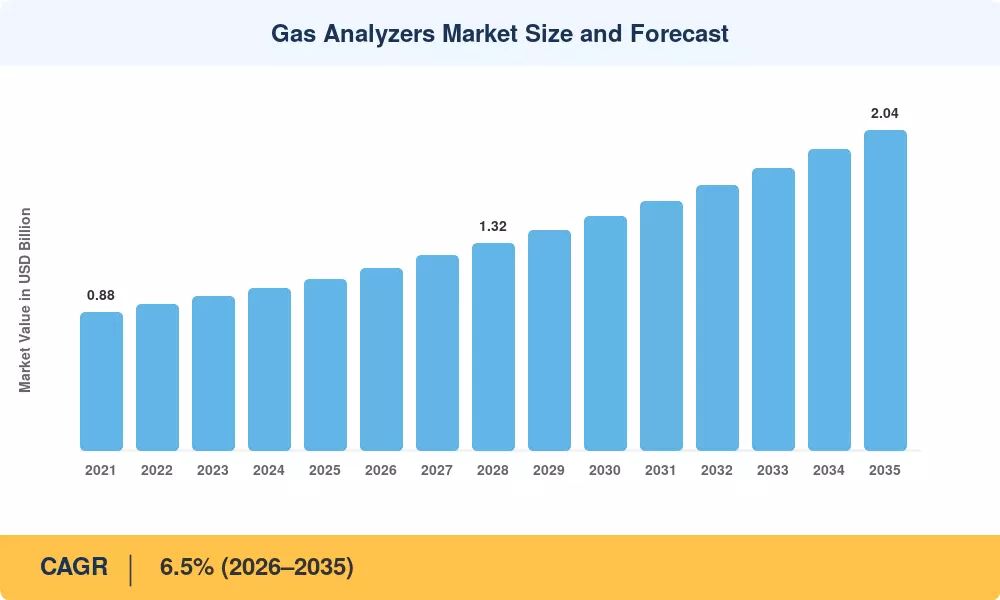
Gas Analyzers Market to Grow from USD 1.09 Billion in 2025 to USD 2.04 Billion by 2035- By Continuous Emissions Monitoring Mandates, Methane Quantification
NY, CA, UNITED STATES, September 16, 2026 /EINPresswire.com/ — As per Market Research Future, the global Gas Analyzers Market size is projected to reach USD 2.04 Billion by 2035 from USD 1.09 Billion in 2025, at a CAGR of 6.5% during the forecast period 2026–2035. The market opened the forecast window at USD 1.16 Billion in 2026.
The 6.5% CAGR—anchored by structural shifts in industrial compliance and process analytics—is propelled by three converging forces: tightening environmental regulation, with the U.S. EPA’s OOOOb/OOOOc methane rules pushing continuous monitoring from an option to a compliance obligation across roughly 900,000 wellheads and the recast EU Industrial Emissions Directive (2024/1785) tightening reporting cadence for some 52,000 installations, driving industrial operators to increasingly adopt certified gas analyzers for continuous emissions monitoring, methane leak detection, and workplace safety; advancements in sensing technology, particularly tunable diode laser absorption spectroscopy (TDLAS), which survives moisture-laden flue streams and drifts less than conventional non-dispersive infrared, significantly improving measurement reliability in ammonia-heavy and wet-gas applications; and the integration of analytics and service-based business models, including analyzer-as-a-service contracting and cloud-based compliance data platforms, that enhance uptime, reduce total cost of ownership, and create recurring revenue streams.
Global industrial technology companies and regulators are amplifying this momentum. The IEA’s Global Methane Tracker attributes over 120 million tonnes of annual energy-sector methane to sources that instrumentation can now quantify directly, while EPA estimates USD 20 billion in cumulative compliance cost through 2038 under its methane rules—each obligated site requiring certified analyzers, data acquisition systems, and quarterly audits. OGMP 2.0 Gold Standard reporting now covers companies representing roughly 42% of global oil and gas production, converting laser-based analyzers from discretionary purchases into audit infrastructure. These forces are creating the regulatory foundation and industrial demand on which the Gas Analyzers Market depends.
Request A Free Sample:
https://www.marketresearchfuture.com/sample_request/23149
Key Market Trends & Growth Drivers
Rising Demand for Continuous Emissions Monitoring
The market is witnessing an increasing demand for continuous monitoring solutions replacing periodic spot sampling. As regulators stop accepting quarterly manual stack-test snapshots, plants now stream hour-level data into compliance dashboards. This trend indicates a structural shift in industrial compliance management, with certified analyzers becoming permanent infrastructure. ABB continues advancing product development through its broadest-in-class CEMS portfolio while strengthening service attach rates above 80% on certified stack installations.
Advancements in Laser and Optical Sensing Technologies
Innovations in sensing technology are becoming a hallmark of the industry. Vendors are exploring tunable diode laser absorption spectroscopy, quantum cascade lasers, and autonomous self-validating platforms with onboard reference cells and algorithmic drift correction. These advancements aim to enhance measurement accuracy in wet, ammonia-heavy flue streams while reducing calibration visits, potentially leading to lower lifecycle costs and increased market penetration. NDIR technology retained 35.6% of market revenue in 2025, while TDLAS is the fastest-expanding technology at a 7.6% CAGR, driven by in-situ ammonia slip measurement.
Integration of Compliance Data and Service-Based Models
The incorporation of cloud analytics and subscription contracting into the industry is gaining traction. Tools such as analyzer-as-a-service programs—bundling hardware, calibration gas, parts, and guaranteed uptime into monthly subscriptions—are opening budgets that outright purchases never penetrated, with early programs reporting contract values 2.3x the corresponding hardware sale over a seven-year term. Honeywell continues investing in connected fenceline monitoring and cloud analytics platforms for refinery consent-decree compliance.
Increasing Prevalence of Methane Regulation and Energy-Transition Analytics
Methane quantification as a financial instrument is a primary driver. The EU Methane Regulation obliges importers to demonstrate monitoring, reporting, and verification equivalence from 2027, and registries covering roughly USD 1.5 trillion in outstanding sustainability-linked debt increasingly require third-party measured data rather than modelled estimates. The market is projected to expand as hydrogen and CCUS projects—over 500 announced globally, each carrying analytical requirements at capture, compression, and injection points—add measurement points that did not exist a decade ago.
Ask for Customization:
https://www.marketresearchfuture.com/ask_for_customize/23149
Market Segment Insights
BY PRODUCT TYPE
Fixed Analyzers: Largest segment with 60.9% revenue share in 2025, anchored by permanent stack and process compliance points that are rarely displaced mid-permit once certified. ABB maintains the broadest CEMS portfolio across utility and cement applications.
Portable Analyzers: Fastest-growing segment at 7.7% CAGR, driven by turnaround inspections, rental fleets, contractor mandates, and confined-space protocols that create a replacement cycle far shorter than the fixed installed base.
BY TECHNOLOGY
NDIR: Largest segment with 35.6% revenue share in 2025, remaining the default for CO, CO2, and hydrocarbon combustion duty on cost and service familiarity.
TDLAS: Fastest-growing technology at 7.6% CAGR, winning where NDIR struggles—moisture-laden flue gas, ammonia slip downstream of SCR units, and applications where sample conditioning adds failure modes. Emerson continues expanding its quantum cascade laser platforms for refinery service.
Electrochemical: Generated USD 0.17 Billion in 2025, concentrated in portable safety instruments and toxic gas detection.
Paramagnetic & Zirconia: Positioned in oxygen purity and combustion efficiency niches, valued at USD 0.09 Billion for zirconia-based boiler trim applications.
BY APPLICATION
Emission Monitoring: Largest application at USD 0.49 Billion in 2025, its durability deriving from permit language rather than discretionary spend.
Safety and Leak Detection: Fastest-growing application at 7.3% CAGR, as insurers and contractors—not only regulators—now specify continuous coverage, and fenceline monitoring settlements in U.S. refining make passive sampling look like an unacceptable liability position.
Process Control: Significant share at 21.4% of revenue in 2025, supporting yield optimisation and combustion tuning.
Ambient Air Quality: Valued at USD 0.08 Billion in 2025, serving municipal networks and fenceline reporting.
BY END-USER VERTICAL
Oil and Gas: Largest segment with 32.1% revenue share in 2025, buying the most and specifying the hardest, with hazardous-area certification and SIL ratings narrowing the qualified vendor list considerably.
Pharmaceutical: Fastest-growing vertical at 7.5% CAGR, as FDA’s Process Analytical Technology framework and continuous bioprocessing reward inline measurement—with validated inline analytics on roughly 31% of new biologics lines commissioned since 2023.
Chemical and Petrochemical: Valued at USD 0.20 Billion in 2025, driven by process safety and product purity requirements.
Power Generation: Significant share at 14.6% of revenue in 2025, anchored by stack compliance and combustion efficiency mandates.
Read Detailed Insights:
https://www.marketresearchfuture.com/reports/gas-analyzers-market-23149
Regional Outlook
North America — Market Leader in Compliance Economics
North America leads with 29.8% of global revenue in 2025, generating around USD 0.32 Billion on the strength of its refining and midstream base. The region’s growth is driven by the EPA OOOOb/OOOOc methane rules across roughly 900,000 wellheads, the Super Emitter Program pushing operators to instrument proactively, and facility payment economics that favour certified continuous monitoring. The United States holds 73.8% of the regional market, while Canada layers provincial equivalency agreements on top. The competitive landscape is characterized by multi-jurisdictional certification portfolios among leading instrument vendors.
Europe — Second Largest Market
Europe was valued at USD 0.29 Billion in 2025, representing the second-largest regional market with a 26.4% share. The region benefits from the recast Industrial Emissions Directive tightening permit review cycles and expanding monitoring obligations, with member states transposing through 2026. German chemical parks have front-loaded procurement to avoid competing for scarce commissioning engineers. Leading countries include Germany, the UK, and France, where major technology companies such as Siemens and Endress+Hauser are heavily invested.
Asia-Pacific — Fastest-Growing Market Segment
The Asia-Pacific region is the fastest-growing market, advancing at a 6.9% CAGR, as India, Vietnam, and Indonesia commission coal and cement capacity carrying mandatory stack monitoring. China holds 41.2% of the regional market on the strength of ultra-low emission standards for power and steel, while India’s Central Pollution Control Board mandate—covering 17 highly polluting industry categories—created a large first-time installed base where after-sales coverage decides renewals. The competitive landscape is evolving with localisation and service-led competition.
Middle East & Africa and South America — Emerging Potential
The Middle East & Africa region contributed USD 0.09 Billion in 2025, driven by Aramco flare minimisation, ADNOC zero-routine-flaring commitments, and LNG export terminal instrumentation, with national oil companies tying supplier scoring to in-country value creation. South America holds around 7.2% of the global share, led by Brazil’s pre-salt offshore platforms and ethanol processing, with Chilean and Peruvian mining driving steady portable demand for underground ventilation compliance.
Competitive Landscape and Recent Developments
The Gas Analyzers Market is characterized by moderate fragmentation and steady technological convergence, driven by tightening regulation and energy-transition analytics worldwide. The top five suppliers hold an estimated 36–40% of global revenue, with differentiation migrating from sensor accuracy—where the field has converged—toward service network density, certification breadth, and data platform integration.
KEY COMPANIES AND RECENT MILESTONES
ABB (CH): Holds an estimated 9–12% revenue share. Offers the broadest CEMS portfolio, laser analyzers, and process gas chromatographs, with strong utility and cement penetration.
Emerson Electric (US) (June 2024): Launched a quantum cascade laser platform for multi-component flue gas measurement, positioned against extractive NDIR trains in refinery service. Holds an estimated 8–11% revenue share tied to its deep refining installed base.
U.S. Environmental Protection Agency (March 2024): Finalised OOOOb/OOOOc standards requiring routine leak surveys and permitting advanced detection technologies, expanding certified instrument demand across upstream assets.
European Union (April 2024): Adopted the recast Industrial Emissions Directive, tightening permit review cycles and broadening monitoring obligations for large industrial installations.
Honeywell (US) (February 2025): Announced an integrated fenceline monitoring offering combining fixed open-path detection with cloud analytics for U.S. refinery consent-decree compliance.
Other Key Players: Siemens (DE), Thermo Fisher Scientific (US), Teledyne Technologies (US), Yokogawa Electric (JP), Servomex / Spectris (GB), AMETEK Process Instruments (US), Endress+Hauser (CH), HORIBA (JP), Drager (DE).
Future Outlook: 2026–2035
The Gas Analyzers Market is projected to reach USD 2.04 billion by 2035, growing at a CAGR of 6.5%, driven by continuous emissions monitoring mandates, methane quantification rules, and pharmaceutical process analytics.
New opportunities lie in:
– Expansion into emerging markets with local assembly and stack monitoring buildout
– Development of hydrogen and CCUS purity analytics for the energy transition
– Investment in autonomous calibration and monetisable compliance data platforms
By 2035, the Gas Analyzers Market is expected to achieve substantial growth and innovation, with the installed base shifting from compliance evidence toward operational intelligence.
Related Reports:
https://www.marketresearchfuture.com/ko/reports/hyperlipidemia-drug-market-30007
https://www.marketresearchfuture.com/fr/reports/urology-devices-market-1120
https://www.marketresearchfuture.com/ja/reports/urology-devices-market-1120
https://www.marketresearchfuture.com/de/reports/urology-devices-market-1120
https://www.marketresearchfuture.com/fr/reports/ultrasound-devices-market-2789
https://www.marketresearchfuture.com/ja/reports/ultrasound-devices-market-2789
https://www.marketresearchfuture.com/de/reports/ultrasound-devices-market-2789
https://www.marketresearchfuture.com/fr/reports/ulcerative-colitis-market-2354
https://www.marketresearchfuture.com/ja/reports/ulcerative-colitis-market-2354
https://www.marketresearchfuture.com/de/reports/ulcerative-colitis-market-2354
Market Research Future
Market Research Future
+1 855-661-4441
email us here
Legal Disclaimer:
EIN Presswire provides this news content “as is” without warranty of any kind. We do not accept any responsibility or liability
for the accuracy, content, images, videos, licenses, completeness, legality, or reliability of the information contained in this
article. If you have any complaints or copyright issues related to this article, kindly contact the author above.

Media gallery