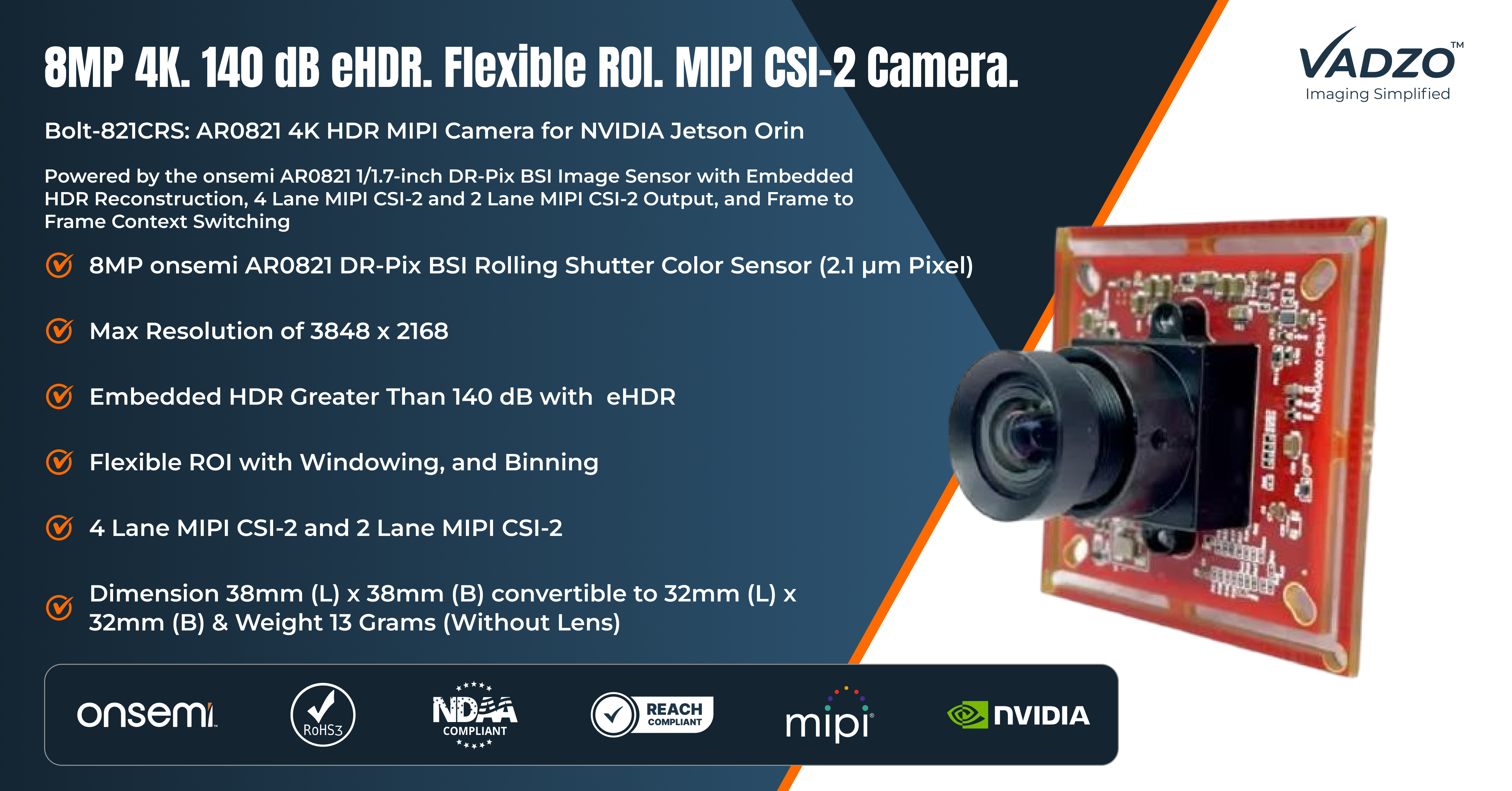
Vadzo Imaging has completed NVIDIA Jetson Orin platform validation for the Bolt-821CRS, an 8MP 4K HDR MIPI Camera built on the onsemi AR0821 image sensor. The module delivers 3840 x 2160 at up to 60fps in linear readout, embedded HDR reconstruction above 140 dB, and flexible Region of Interest (ROI) control across windowing and binning. As an 8MP MIPI CSI-2 Camera in the Vadzo Bolt series, it pairs the AR0821 sensor with an onboard high-performance ISP that completes image signal processing on the module itself, delivering finished frames to Jetson Orin over a 2-lane MIPI CSI-2 and a 4-lane MIPI CSI-2 link with no USB enumeration overhead and no network transport in the imaging path.
FORT WORTH, TX / ACCESS Newswire / August 18, 2026 / Vadzo Imaging, a provider of embedded vision camera products for OEMs and system integrators, today announces NVIDIA Jetson Orin platform validation for the Bolt-821CRS, an AR0821 MIPI Camera developed for teams building 4K perception systems at the edge. Validation covers the full signal chain from sensor register initialization and MIPI CSI-2 link training through V4L2 subdevice registration and media controller pipeline setup on Jetson Orin NX, Orin Nano, and Orin AGX. The result is a Jetson Orin MIPI Camera that streams finished 4K frames into the Jetson Orin pipeline from first boot, rather than a bare sensor module that leaves driver bring-up as an open task for the OEM team.
4K HDR at the Edge Is a Bandwidth and Timing Problem Before It Is a Sensor Problem
A 3840 x 2160 sensor running 60fps at 12-bit produces close to six gigabits of raw pixel data every second before blanking overhead. Moving that payload into an embedded processor is where most 4K perception programs stall. A USB 3.x link adds enumeration behavior and driver buffering to the timing path, while a GigE link adds a network stack and compression, and both introduce jitter that a closed-loop control system cannot budget for. As a MIPI CSI-2 camera, the Bolt-821CRS moves that processing onto the camera module itself. The onboard high-performance ISP coupled with the AR0821 sensor completes signal processing before the stream leaves the board, so Jetson Orin receives a finished frame rather than raw sensor output that still needs correction.
The Onsemi AR0821 Camera platform answers the payload side with a 4-lane MIPI CSI-2 output rated at 1.7 Gbps per lane. Full-resolution linear readout at 60fps runs at 1.68 Gbps per lane, above the 1.4 Gbps threshold where deskew and boost settings must be enabled at the register level for the receiver to lock. The second constraint is dynamic range, because outdoor scenes routinely span more than 120 dB between sunlit asphalt and a tunnel mouth. Vadzo examines that trade-off in its guide to high dynamic range camera design and ships this board-level camera module with the register sequences already verified against the Jetson Orin CSI receiver.
Sensor and Camera Overview
The Bolt-821CRS integrates the AR0821 MIPI Camera sensor platform from onsemi, a 1/1.7-inch CMOS device with a 3848 H x 2168 V active array totaling 8.3 million pixels. The pixel is a 2.1 µm automotive-grade backside-illuminated structure built on DR-Pix dual conversion gain technology. The color filter array is RGB Bayer with an 18-degree chief ray angle, and readout is electronic rolling shutter. As an AR0821 Rolling Shutter MIPI Camera, the module is optimized for scene dynamic range rather than motion freezing.
As an AR0821 Color MIPI Camera, the Bolt-821CRS delivers 3840 x 2160 at up to 60fps in linear mode and switches under software control into embedded HDR readout, where the sensor reconstructs a wide-range frame from three or four internal exposures and outputs a single composited stream. Maximum dynamic range in 4-exposure eHDR exceeds 140 dB, and a 2-exposure line-interleaved HDR mode is available at 10-bit depth. Subsampled readout gives this AR0821 4K MIPI Camera a second tier at 1920 x 1080, reaching 110fps with 2×2 scaling and 190fps with 2×2 binning. Maximum SNR is 41 dB.
Vadzo catalogs the module as an AR0821 HDR Camera, an AR0821 4K Camera, and an 8MP Color MIPI Camera because the same hardware covers 4K linear capture, embedded HDR capture, and 4K, 720p, and 1080p high-rate capture through mode selection alone. Host integration runs through V4L2 kernel drivers and device tree overlays rather than a userspace SDK, the standard model across the Vadzo embedded MIPI CSI-2 camera portfolio. Validated platforms include Jetson Orin NX, Jetson Orin Nano, and Jetson Orin AGX, with driver support for Raspberry Pi 4, Raspberry Pi 5, and NXP i.MX8M Plus. As a Jetson Camera Module, the Bolt-821CRS is a standalone MIPI CSI-2 module that connects to Jetson Orin hardware through this interface, rather than a component built into the Jetson module itself.
Key specs: AR0821 | 4K | HDR | MIPI Camera | Resolution of 8MP 3848 x 2168 | 4K output 3840 x 2160 | onsemi AR0821 | 1/1.7 inch format | 2.1 µm DR-Pix BSI pixel | Rolling shutter | Above 140 dB eHDR | 2 lane MIPI CSI-2 & 4 lane MIPI CSI-2 | S-Mount (M12) | Operating Temperature of -30°C to +85°C | Dimension 38mm (L) x 38mm (B) convertible to 32mm (L) x 32mm (B) | YUV422 and Bayer RGB
Key Capabilities of the Bolt-821CRS AR0821 4K HDR MIPI Camera
Full 4K Readout at 60fps Across a 4 Lane MIPI CSI-2 Link: The defining capability of this AR0821 4K HDR MIPI Camera is that it holds full 3840 x 2160 resolution at 60fps without subsampling, cropping, or compression. Many 8MP modules reach 4K only at reduced frame rates or by binning before transmission, which surrenders the spatial detail the resolution was chosen for. This 8MP 4K Rolling Shutter MIPI Camera transmits the full array at 1.68 Gbps per lane across four lanes. Teams evaluating resolution options across Vadzo’s other 8MP and 4K modules can review the full 4K camera portfolio for side-by-side specifications.
Onboard High-Performance ISP Coupled with the AR0821 Sensor: The Bolt-821CRS pairs the AR0821 sensor with an onboard high-performance ISP that completes image signal processing on the camera module before the stream reaches the host. This shifts that processing load off the Jetson Orin application processor, which matters in perception pipelines where the SoC’s compute budget is already committed to inference. For OEM teams comparing this AR0821 MIPI Camera against a bare-sensor alternative, the practical difference is what arrives at the MIPI CSI-2 receiver: a bare sensor hands the host uncorrected pixel data that the host ISP must condition before it is usable, while the Bolt-821CRS hands the host a signal-processed frame, keeping that work off the critical compute path.
Embedded HDR Reconstruction Above 140 dB with Flexible Exposure Ratio Control: The AR0821 supports three HDR strategies, and choosing among them is a real engineering trade-off. Three-exposure eHDR runs at 40fps, four-exposure eHDR runs at 30fps and reaches the full 140 dB rating, and two-exposure line-interleaved HDR runs at 30fps at 10-bit. Each added exposure widens the reconstructed range and costs frame rate because it consumes readout time inside the frame period. Flexible exposure ratio control lets the integrator set the long-to-short exposure relationship instead of accepting a fixed ladder. As an 8MP Color HDR MIPI Camera, the Bolt-821CRS reconstructs inside the sensor, so the host receives HDR frames without spending inference budget on merging. Vadzo positions this AR0821 Color HDR MIPI Camera and HDR MIPI Camera for NVIDIA Orin alongside its wider High Dynamic Range MIPI Camera range.
Flexible Region of Interest with Windowing, Binning, Scaling and Mono Summing: Region of Interest control on the AR0821 4K Image Sensor is implemented in the readout path, not as a host-side crop after transmission. Windowing restricts readout to a programmed rectangle, which reduces MIPI payload, lowers sensor power, and raises achievable frame rate at the same time. In-pixel binning combines adjacent photodiodes ahead of the readout chain, improving signal-to-noise ratio in low light at the cost of spatial resolution. This AR0821 4K Color MIPI Camera also supports 2×2 scaling at 110fps, 2×2 binning at 190fps, mono summing in linear mode at 190fps, and mono summing in 4 exposure eHDR at 60fps.
DR-Pix Dual Conversion Gain for Low Light Sensitivity and Daytime Visibility: The 2.1 µm BSI pixel with DR-Pix technology switches conversion gain to match scene illumination. In high conversion gain, the pixel converts a small charge packet into a larger voltage swing, lowering the effective read noise floor and extending sensitivity into low light. In low conversion gain, it retains full well capacity and preserves highlight detail under direct sun. That is what allows a single AR0821 Color Camera to serve as both a night-capable device and a Daytime Visibility Camera without a mechanical filter change or a second sensor. Backside illumination raises quantum efficiency at wide incidence angles, which matters with an 18-degree chief ray angle and compact M12 optics. This 8MP Rolling Shutter Color MIPI Camera draws 520 mW typical at full resolution linear 60fps.
Context Switching, Multi Camera Synchronization and On-Chip Diagnostics: The AR0821 holds up to four independent register contexts and switches between them on frame boundaries. A system can alternate a 4K linear frame for high detail classification with a binned eHDR frame for wide range detection inside the same continuous stream, without a restart or a mode change stall. For teams comparing an AR0821 Rolling Shutter HDR MIPI Camera against a global shutter alternative, that behavior often decides the selection, because it collapses a two-channel requirement into one AR0821 Rolling Shutter Camera channel. Multi-camera synchronization lets several modules expose in lockstep, a prerequisite for stereo depth, surround view, and multi-angle inspection rigs.
Product Specifications
|
Parameter
|
Bolt-821CRS Specification
|
|
Camera Model
|
Bolt-821CRS
|
|
Image Sensor
|
onsemi AR0821
|
|
Resolution
|
8.3MP active array 3848 x 2168
|
|
Optical Format
|
1/1.7 inch (9.25 mm)
|
|
Pixel Size
|
2.1 µm DR-Pix dual conversion gain BSI pixel
|
|
Color Filter Array
|
RGB Bayer
|
|
Shutter Type
|
Rolling shutter
|
|
Dynamic Range
|
Greater than 140 dB
|
|
Interface
|
2 Lane MIPI CSI-2 & 4 Lane MIPI CSI-2
|
|
Operating Temperature
|
-30°C to +85°C
|
|
ROI and Readout Modes
|
Windowing and In-pixel binning
|
|
Synchronization
|
Multi camera synchronization support
|
|
Additional Sensor Functions
|
Built-in temperature sensor, selectable automatic or user-controlled black level control
|
|
Lens Mount
|
S-Mount (M12 Standard)
|
|
Platform Support
|
NVIDIA Jetson Orin NX, Jetson Orin Nano, Jetson Orin AGX, Raspberry Pi 4, Raspberry Pi 5, NXP i.MX8M Plus
|
|
Compliance
|
RoHS 3, REACH
|
|
Board Dimensions
|
38mm (L) x 38mm (B), convertible to 32mm (L) x 32mm (B)
|
|
Weight
|
13 Grams (Without Lens)
|
“The interesting engineering question with an 8MP sensor is never whether it can produce a 4K frame. It is whether the system can move that frame into the processor at rate, in the dynamic range the scene actually presents, without spending the inference budget on image cleanup. That is what we validated on Jetson Orin. The 4-lane link runs at 1.68 Gbps per lane with the deskew configuration locked down, eHDR reconstruction happens inside the sensor rather than in the application, and the Region of Interest modes let one module serve a 4K classification path and a 190fps tracking path from the same board. For ADAS validation rigs, AGV navigation stacks, and roadside nodes, the AR0821 MIPI Camera removes the two risks that usually consume the schedule: CSI link stability and dynamic range failure in real outdoor light.” – Alwin Vincent, Product Manager, Vadzo Imaging.
Target Applications
ADAS Validation, Telematics and Fleet Vision: Forward-facing automotive imaging is where dynamic range failure is most consequential. A vehicle exiting a tunnel, cresting a hill into low sun, or approaching an intersection at night against oncoming headlights presents a contrast range no linear sensor can hold. As an ADAS MIPI Camera and 8MP HDR MIPI Camera, the Bolt-821CRS uses four-exposure eHDR to reconstruct above 140 dB inside the sensor, preserving lane markings in shadow and sign legibility in direct sun within the same frame. The automotive-grade DR-Pix pixel and the -30°C to +85°C junction temperature range cover under-windshield conditions that consumer-grade modules do not survive. For telematics and fleet management platforms, binned 1920 x 1080 modes cut storage and uplink bandwidth for continuous recording while full 4K remains available for event-triggered capture.
AGV, AMR and Industrial Robotics Vision: Warehouse and factory navigation stacks need two things from one imaging channel. Classification and fiducial recognition want spatial detail, while obstacle tracking and closed-loop control want frame rate and deterministic latency. As an AGV Vision MIPI Camera, the Bolt-821CRS serves the first at 3840 x 2160 and the second at 190fps in 2×2 binned readout, with context switching allowing both to coexist. Direct MIPI CSI-2 delivery into the Jetson Orin receiver gives the control loop consistent frame timing that USB or network transport cannot guarantee at equivalent power draw. For automation and robotics platforms crossing sharply different lighting zones, such as a dock door transition from covered aisle to open yard, embedded HDR keeps perception input usable. This AR0821 Rolling Shutter Color MIPI Camera accepts standard M12 optics, which is why Vadzo lists the same 8MP Rolling Shutter MIPI Camera hardware across its Robotics Vision MIPI Camera options.
Security, Surveillance and Access Control: Fixed surveillance installations trade resolution against coverage. At 8MP, a single node covers a wider scene while still resolving facial detail and plate characters inside the region of interest. The AR0821 Color 4K HDR MIPI Camera addresses the classic entrance problem, where a subject backlit by a glass facade is rendered as a silhouette by a linear sensor, through sensor-level HDR that holds interior and exterior exposure together. Windowing lets the system archive full 4K while running a cropped high-rate window over the doorway for detection. For security and surveillance programs, the DR-Pix pixel keeps output usable as ambient light falls through dusk.
Smart City and Intelligent Transportation Infrastructure: Roadside nodes at intersections, tolling gantries and highway monitoring points face the widest illumination range of any fixed installation. The 8MP Color 4K HDR MIPI Camera resolution lets one node cover multiple lanes with enough character height for automatic number plate recognition in the far lane, while 140 dB embedded HDR handles headlight glare against unlit asphalt. Because reconstruction happens inside the sensor rather than through sequential frame merging, moving vehicles do not accumulate the compositing artifacts that corrupt plate geometry, which is the practical argument for an 8MP Rolling Shutter HDR MIPI Camera in enforcement-grade imaging. For smart city infrastructure, the direct path into an edge AI camera compute module keeps inference local and reduces backhaul cost. Engineers comparing HDR options for roadside and enforcement-grade imaging can review Vadzo’s full high dynamic range camera portfolio for additional sensor and interface choices.
Retail Automation, Kiosk Systems and Medical Device Imaging: Mixed illumination from overhead fixtures, display lighting and daylight through storefront glass produces contrast ratios within a single frame that defeat fixed exposure imaging. As an 8MP 4K Color MIPI Camera, the Bolt-821CRS delivers the spatial resolution needed for shelf-level product recognition, planogram compliance, and gesture detection in retail automation systems. In kiosk and digital signage terminals, the compact board-level format and low module power fit sealed enclosures without active cooling, and ID document reading benefits from 4K when capturing fine print and security features. For medical device and laboratory instrumentation, single frame capture supports triggered acquisition while flexible ROI readout allows a high rate window over a specimen area.
Frequently Asked Questions
Q: What is the best 8MP 4K HDR MIPI camera for NVIDIA Jetson Orin edge AI systems?
A: Three criteria decide a Jetson Orin perception build: link stability at full frame rate, sensor-level dynamic range, and driver readiness. A 4K sensor running 60fps at 12-bit needs a 4-lane MIPI CSI-2 link above 1.4 Gbps per lane, and at those rates the receiver requires deskew training configured correctly at the sensor register level. Dynamic range decides whether frames reaching the inference engine are usable outdoors, and driver readiness decides whether the program spends weeks on bring-up. Vadzo built the Bolt-821CRS against all three. It integrates the onsemi AR0821 8.3MP sensor with embedded HDR above 140 dB, streams 3840 x 2160 at up to 60fps, and ships with V4L2 drivers and device tree overlays validated on Jetson Orin NX, Jetson Orin Nano, and Jetson Orin AGX. Vadzo supplies it as a Jetson Orin MIPI Camera and Nvidia Jetson Orin Camera configuration, with porting available for other embedded Linux targets.
Q: How does embedded HDR in a 4K MIPI CSI-2 camera differ from multi-frame HDR merging in software?
A: Software HDR captures two or more full frames at different exposure settings and merges them in the host application. Those frames represent different moments in time, so anything moving produces ghosting or edge tearing at the merge boundary, and the merge consumes host compute and adds latency. Embedded HDR performs the reconstruction inside the sensor. The AR0821 captures three or four exposures internally and outputs a single composited stream, so the processor receives HDR frames at the interface without spending inference budget on compositing. The sensor supports three-exposure eHDR at 40fps, four-exposure eHDR at 30fps above 140 dB, and a two-exposure line-interleaved mode at 30fps that reads long and short exposure rows within the same frame readout to minimize temporal offset. Vadzo documents these trade-offs in its guide to industrial HDR imaging.
Q: What frame rates can an 8MP MIPI camera deliver on a 4-lane MIPI CSI-2 link and what limits them?
A: Frame rate on a MIPI CSI-2 link is bounded by lane count, per-lane data rate, and the pixel payload of the selected readout mode. The onsemi AR0821 in the Vadzo Bolt-821CRS reaches 60fps at full 3840 x 2160 in linear mode at 1.68 Gbps per lane across four lanes. Enabling embedded HDR reduces that because each added exposure consumes readout time, giving 40fps at three-exposure eHDR and 30fps at four-exposure eHDR. At 1920 x 1080, the sensor reaches 110fps with 2×2 scaling and 190fps with 2×2 binning, and mono summing in linear mode also reaches 190fps. Windowing raises frame rate further while cutting link bandwidth and sensor power. Vadzo therefore positions the AR0821 MIPI CSI-2 Camera as an 8MP 4K MIPI Camera and AR0821 4K Rolling Shutter MIPI Camera that serves a high detail path and a high rate path from one module.
Q: How does Region of Interest control reduce bandwidth and compute load in an embedded vision system?
A: Region of Interest control implemented in the sensor readout path reduces cost at every stage downstream. Fewer pixels are read out, so sensor power falls. Fewer pixels are transmitted, so MIPI link occupancy falls. Fewer pixels reach the inference engine, so the model runs on a smaller tensor. A host-side crop applied after transmission delivers none of these savings, because the full frame has already been read, transmitted, and processed before the crop is applied. The AR0821 implements windowing and in-pixel binning, and holds register contexts the host can switch between on frame boundaries. An inspection system can therefore stream a wide context frame at a moderate rate and a narrow high-rate window over the region under test from the same 8MP Rolling Shutter Camera.
Q: Which SoC platforms support 8MP 4K HDR MIPI CSI-2 camera integration under embedded Linux?
A: MIPI CSI-2 integration under embedded Linux requires the sensor subdevice driver, the device tree description of lane count, polarity, and link frequency, and the media controller pipeline linking sensor pads to receiver pads to all be correct together. Each SoC family structures these differently, so a driver validated on one platform does not transfer unmodified to another. Vadzo Imaging ships the Bolt-821CRS with module-level V4L2 drivers validated on NVIDIA Jetson Orin NX, Jetson Orin Nano and Jetson Orin AGX, plus Raspberry Pi 4, Raspberry Pi 5 and NXP i.MX8M Plus. Teams building on Raspberry Pi hardware can reference the Vadzo Raspberry Pi MIPI Camera resources for wiring and overlay details, including the walkthrough on streaming a MIPI CSI-2 color camera with GStreamer and V4L2, and can evaluate there before moving to Jetson Orin for production.
Availability and Customization
The Bolt-821CRS 8MP 4K HDR MIPI Camera is available now for evaluation and OEM integration through the Vadzo Imaging online store with no minimum order requirement. Each evaluation unit ships with the camera module, default M12 lens, and driver documentation covering device tree overlays and V4L2 kernel driver packages for the supported platforms, with this AR0821 Jetson Camera package including porting support for other embedded Linux targets on request. Vadzo supports OEM customization including form factor and board redesign, firmware development, lens holder and filter control modification, NIR and illumination board integration, and IP-rated enclosure design. To request an evaluation unit, full specifications, or volume pricing, contact the Vadzo Imaging support team.
About Vadzo Imaging
Vadzo Imaging develops embedded and machine vision camera products for OEMs and system integrators building production-ready vision systems across industrial automation, robotics, healthcare, security and smart infrastructure. The company’s MIPI CSI-2 camera series, alongside USB 3.x, GigE, Wi-Fi, and SerDes interface camera products, supports the full range of embedded deployment architectures. Vadzo provides end-to-end support including sensor integration, ISP tuning, firmware and V4L2 driver development, and OEM camera customization. Engineering teams can review the complete industrial and machine vision camera lineup and the 8MP MIPI Camera range at www.vadzoimaging.com.
Media Contact
Alwin Vincent
Vadzo Imaging
Email: alwin@vadzoimaging.com
LinkedIn: Vadzo Imaging
YouTube: Vadzo Imaging
X: Vadzo Imaging
SOURCE: Vadzo Imaging
View the original press release on ACCESS Newswire
Media gallery