Lawful Interception Market is growing rapidly as governments strengthen cybersecurity, digital surveillance, and compliance capabilities worldwide.
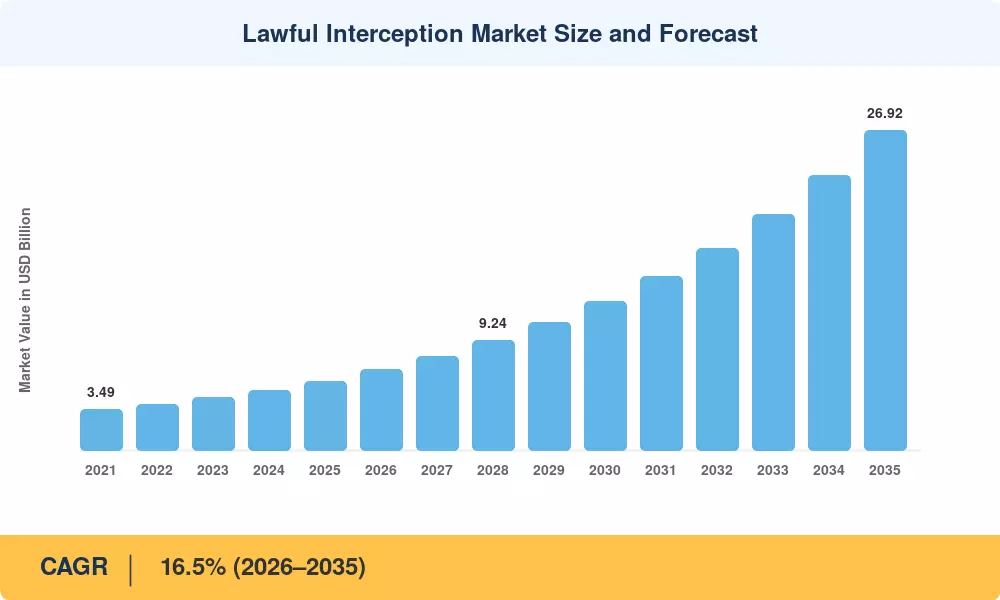
NEW YORK(NY), NY, UNITED STATES, July 23, 2026 /EINPresswire.com/ — The Lawful Interception Market is experiencing significant expansion as governments, law enforcement agencies, and intelligence organizations increase investments in advanced surveillance technologies to combat cybercrime, terrorism, organized crime, financial fraud, and national security threats. The growing digitalization of communication platforms, the rapid adoption of cloud services, encrypted messaging applications, Voice over Internet Protocol (VoIP), and fifth-generation mobile networks have transformed the communication ecosystem, making lawful interception technologies an essential component of modern security infrastructure. Lawful Interception Market was valued at USD 5.84 Billion in 2025, with the forecast period beginning at USD 6.81 Billion in 2026 and projected to reach USD 26.92 Billion by 2035, registering a CAGR of 16.5% during 2026–2035.
The increasing volume of digital communications, combined with stricter regulatory frameworks across developed and emerging economies, continues to encourage telecommunications providers and internet service providers to deploy sophisticated interception solutions capable of supporting multiple communication protocols while maintaining legal compliance. Artificial intelligence, machine learning, cloud-native analytics, and real-time data monitoring technologies are further reshaping the industry by enabling faster intelligence gathering, improved threat detection, and enhanced forensic investigations. As digital transformation accelerates across industries, lawful interception solutions are becoming increasingly integrated into national cybersecurity strategies, creating sustained demand for advanced interception platforms capable of supporting evolving communication technologies.
Market Segment Analysis
The Lawful Interception Market can be segmented based on component, network technology, communication type, deployment model, end user, and region. By component, the market consists of solutions and professional services, with software platforms accounting for a substantial share due to their ability to process, monitor, analyze, and store intercepted communication data efficiently. Services including implementation, consulting, maintenance, and system integration continue to witness growing adoption as organizations modernize interception infrastructure. Based on network technology, the market includes fixed networks, mobile networks, broadband networks, satellite communications, and IP-based communications, with IP and mobile communications representing the fastest-growing segments because of increasing smartphone usage and internet-based communication.
Deployment models include on-premise and cloud-based solutions, with cloud deployment gaining traction because of its scalability, operational flexibility, and cost efficiency. By end user, the market serves government agencies, law enforcement organizations, intelligence agencies, defense departments, telecom operators, and cybersecurity authorities. Telecom service providers remain major adopters as regulatory authorities require communication networks to support lawful interception capabilities. The increasing deployment of 5G infrastructure, software-defined networking, and virtualized telecom environments is also driving demand for advanced interception systems capable of handling high-speed encrypted communications across diverse digital ecosystems.
Download Sample Pages of Research Overview –
https://www.marketresearchfuture.com/sample_request/9596
Key Growth Drivers
Several factors are accelerating the growth of the Lawful Interception Market, including increasing cyber threats, rising national security concerns, expanding digital communication channels, and evolving regulatory compliance requirements. Governments across the globe continue strengthening legal frameworks that require telecom operators and communication service providers to implement lawful interception capabilities for authorized investigations. The widespread adoption of encrypted messaging platforms has increased the complexity of digital investigations, encouraging continuous innovation in interception technologies. Major technology providers including Nokia, Ericsson, Cisco Systems, Verint Systems, BAE Systems, SS8 Networks, AQSACOM, NEC Corporation, Elbit Systems, and Thales Group are investing heavily in artificial intelligence, cloud analytics, real-time monitoring, and advanced intelligence solutions to enhance lawful interception capabilities.
The expansion of smart cities, connected infrastructure, Internet of Things devices, and high-speed mobile networks has significantly increased communication data volumes, requiring more sophisticated monitoring solutions. Rising investments in public safety initiatives, cross-border intelligence collaboration, and cybersecurity modernization programs further contribute to sustained market expansion. Additionally, increasing digital financial transactions, remote working environments, cloud communications, and virtual collaboration platforms continue creating new opportunities for lawful interception technologies capable of supporting secure and legally compliant investigations.
Emerging Market Opportunities
The rapid deployment of fifth-generation mobile networks presents one of the most promising opportunities for the Lawful Interception Market. The increasing adoption of cloud-native telecom architectures, network function virtualization, edge computing, and software-defined networking introduces new monitoring requirements that demand innovative interception solutions. Artificial intelligence and machine learning offer substantial opportunities for automating threat detection, behavioral analytics, and intelligence processing, enabling investigators to identify suspicious communication patterns more efficiently. Growing adoption of Internet of Things ecosystems across healthcare, transportation, manufacturing, utilities, and smart cities generates enormous volumes of connected device communications that require secure monitoring frameworks.
Cloud-based interception platforms are gaining popularity because they simplify deployment while improving scalability and reducing infrastructure costs. Emerging economies continue investing in digital governance, public safety modernization, border security, and cyber defense programs, creating substantial long-term opportunities for technology vendors. Increasing collaboration between telecom operators, cybersecurity companies, government agencies, and cloud infrastructure providers is expected to accelerate innovation, enabling next-generation interception platforms capable of supporting encrypted communications, real-time analytics, and multi-network intelligence gathering while ensuring compliance with evolving legal standards.
Market Challenges and Constraints
Despite its strong growth prospects, the Lawful Interception Market faces several challenges that could influence adoption across different regions. Privacy concerns remain one of the most significant barriers as governments and regulatory authorities seek to balance national security objectives with individual data protection rights. The increasing adoption of end-to-end encryption by communication platforms presents technical limitations for interception systems, requiring continuous technological advancements and legal adaptations. Rapidly evolving communication technologies, including decentralized applications, encrypted cloud communications, blockchain-based messaging, and peer-to-peer networking, create additional complexities for interception providers.
Compliance requirements differ significantly across countries, making global deployment more challenging for multinational technology vendors. High implementation costs, infrastructure modernization expenses, and integration challenges with legacy telecom systems may discourage adoption among smaller communication service providers. The growing sophistication of cybercriminals, combined with the increasing use of anonymous communication platforms, virtual private networks, and advanced encryption protocols, requires continuous investment in research and development to maintain effective interception capabilities while respecting international legal and ethical frameworks.
You can Buy This Report Her –
https://www.marketresearchfuture.com/checkout?currency=one_user-USD&report_id=9596
Leading Industry Participants
The competitive landscape of the Lawful Interception Market includes global telecommunications equipment manufacturers, cybersecurity specialists, defense technology companies, and specialized surveillance solution providers focused on continuous innovation. Industry leaders are strengthening their market positions through strategic acquisitions, technology partnerships, research investments, and product innovation initiatives. Companies are increasingly integrating artificial intelligence, predictive analytics, automation, cloud computing, and advanced cybersecurity capabilities into interception platforms to improve operational efficiency and investigative accuracy.
Vendors are also expanding support for multi-network environments, including 5G, LTE, broadband, satellite, Voice over Internet Protocol, and cloud communications. Strategic collaborations between telecom operators, government agencies, cybersecurity firms, and intelligence organizations continue accelerating solution development while improving compliance with evolving regulatory standards. Product differentiation increasingly focuses on scalability, encryption compatibility, real-time intelligence processing, cloud-native deployment, interoperability, and advanced analytics capabilities that enable secure and legally compliant communication monitoring across rapidly evolving digital infrastructures.
Regional Market Insights
North America continues to dominate the Lawful Interception Market due to advanced telecommunications infrastructure, strong cybersecurity investments, extensive law enforcement modernization programs, and comprehensive regulatory frameworks supporting authorized surveillance activities. The United States remains a major contributor because of ongoing investments in intelligence capabilities, digital security initiatives, and advanced communication monitoring technologies. Europe maintains a significant market share supported by strict regulatory compliance, expanding digital transformation, and increasing investments in cybersecurity and public safety.
Countries including Germany, the United Kingdom, and France continue upgrading interception infrastructure to address sophisticated cyber threats and organized criminal activities. The Asia-Pacific region is expected to record the fastest growth during the forecast period as governments accelerate digital infrastructure development, deploy large-scale 5G networks, and strengthen cybersecurity capabilities across rapidly expanding digital economies. China, India, Japan, South Korea, and Southeast Asian countries continue investing heavily in telecommunications modernization and national security programs. Latin America, the Middle East, and Africa are also experiencing steady market expansion as governments improve communication infrastructure, strengthen law enforcement capabilities, and implement advanced surveillance systems to combat evolving security threats.
Recent Industry Developments
Recent developments within the Lawful Interception Market demonstrate increasing emphasis on artificial intelligence integration, cloud-native deployment models, and support for encrypted communication monitoring. Technology vendors continue introducing advanced analytics platforms capable of processing large-scale communication data with improved speed, accuracy, and operational efficiency. Telecom equipment manufacturers are enhancing 5G-compatible interception capabilities to support virtualized network environments and software-defined architectures. Cloud-based monitoring solutions are becoming increasingly popular because they offer flexible deployment, centralized management, and simplified scalability for government agencies and communication service providers.
Strategic partnerships between cybersecurity firms, telecom operators, cloud providers, and defense organizations are accelerating the development of intelligent interception solutions capable of addressing emerging communication technologies. Vendors are also investing in automation, predictive threat intelligence, digital forensic capabilities, and secure data management to improve investigative workflows while maintaining compliance with evolving privacy regulations and international legal standards.
Explore the In-Depth Report Overview – https://www.marketresearchfuture.com/reports/lawful-interception-market-9596
Future Market Outlook
The future of the Lawful Interception Market remains highly promising as digital communications continue expanding across governments, enterprises, financial institutions, healthcare organizations, and critical infrastructure sectors. The ongoing deployment of 5G networks, artificial intelligence, cloud computing, edge computing, and Internet of Things technologies will continue generating new communication channels that require secure and legally authorized monitoring capabilities. Increasing cyber threats, sophisticated criminal networks, cross-border cybercrime, and growing concerns regarding national security will encourage governments worldwide to strengthen lawful interception frameworks.
Technology providers are expected to focus on intelligent automation, advanced analytics, encrypted communication support, cloud-native architectures, and scalable deployment models capable of addressing future communication environments. Continuous regulatory evolution, expanding digital transformation initiatives, and increasing public safety investments are likely to support sustained market growth throughout the forecast period. As organizations modernize telecommunications infrastructure and cybersecurity capabilities, lawful interception technologies will remain an essential component of digital security strategies, ensuring regulatory compliance while enabling effective intelligence gathering and public safety operations.
Frequently Asked Questions (FAQs)
What is the Lawful Interception Market?
The Lawful Interception Market consists of technologies, software, hardware, and services that enable authorized government agencies and law enforcement organizations to monitor and analyze communications in accordance with legal regulations.
What is driving the growth of the Lawful Interception Market?
The primary growth drivers include increasing cyber threats, rising terrorism concerns, expanding 5G networks, stricter government regulations, rapid digital communication adoption, and advancements in artificial intelligence and cloud technologies.
Which industries are the major users of lawful interception solutions?
Government agencies, intelligence organizations, law enforcement departments, telecom operators, defense organizations, and cybersecurity agencies are the primary users of lawful interception technologies.
Which region dominates the Lawful Interception Market?
North America currently leads the market due to strong cybersecurity investments, advanced telecom infrastructure, and well-established regulatory frameworks, while Asia-Pacific is expected to witness the fastest growth.
Who are the leading companies in the Lawful Interception Market?
Major participants include Nokia, Ericsson, Cisco Systems, Verint Systems, BAE Systems, SS8 Networks, AQSACOM, NEC Corporation, Elbit Systems, and Thales Group.
What technologies will shape the future of the Lawful Interception Market?
Artificial intelligence, machine learning, cloud computing, edge computing, big data analytics, 5G connectivity, and advanced encryption monitoring technologies are expected to play a critical role in future market development.
➤➤Access Comprehensive Regional and Country Analysis Reports Related to the Main Keyword.
China Lawful Interception Market-
https://www.marketresearchfuture.com/reports/china-lawful-interception-market-57986
Gcc Lawful Interception Market-
https://www.marketresearchfuture.com/reports/gcc-lawful-interception-market-57984
Germany Lawful Interception Market-
https://www.marketresearchfuture.com/reports/germany-lawful-interception-market-57982
India Lawful Interception Market-
https://www.marketresearchfuture.com/reports/india-lawful-interception-market-57985
Japan Lawful Interception Market-
https://www.marketresearchfuture.com/reports/japan-lawful-interception-market-57983
South Korea Lawful Interception Market-
https://www.marketresearchfuture.com/reports/south-korea-lawful-interception-market-57981
Spain Lawful Interception Market-
https://www.marketresearchfuture.com/reports/spain-lawful-interception-market-57987
Us Lawful Interception Market-
https://www.marketresearchfuture.com/reports/us-lawful-interception-market-14442
Sagar Kadam
Market Research Future
+ + +1 628-258-0071
email us here
Legal Disclaimer:
EIN Presswire provides this news content “as is” without warranty of any kind. We do not accept any responsibility or liability
for the accuracy, content, images, videos, licenses, completeness, legality, or reliability of the information contained in this
article. If you have any complaints or copyright issues related to this article, kindly contact the author above.

Media gallery