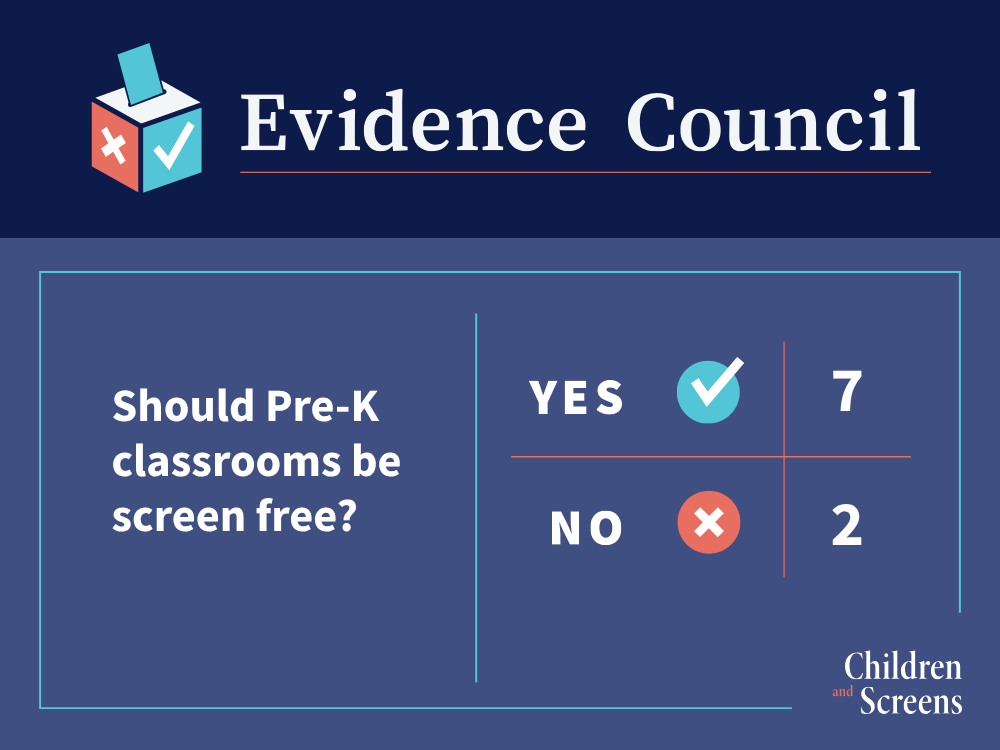
NEW YORK, NY, UNITED STATES, June 11, 2026 /EINPresswire.com/ — A strong majority of leading child development and mental health experts agree that Pre-K classrooms should be screen free, citing the importance of play, social interaction, movement, and hands-on experiences during a critical stage of early development.
In its latest vote-based position, the Children and Screens Evidence Council voted 7–2 in favor of screen-free Pre-K classrooms. Read the full report.
“Pre-K classrooms are uniquely important environments for helping young children develop the social, emotional, cognitive, and physical skills they need to thrive,” said Kris Perry, Executive Director of Children and Screens. “This vote reflects broad expert agreement that early childhood settings should prioritize play, movement, communication, and human connection during one of the most important periods of development.”
Council members who voted in favor highlighted several key considerations:
• Social and emotional development: Face-to-face interactions help young children develop communication skills, emotional understanding, and healthy relationships.
• The importance of play: Real and imaginary play, movement, creativity, and hands-on experiences are essential components of early learning and development.
• Displacement of healthy activities: Screen use can replace physical activity, peer engagement, and exploratory learning, even when the content itself is considered high quality.
• Risk of developmental harm: Research suggests excessive screen exposure in early childhood is associated with increased risks of attention problems, language and social delays, behavioral challenges, and sleep disruption.
“Early childhood is a precious time for learning about the physical world and for nurturing human relationships,” said Dr. Naomi Baron, Council member. “Encouraging children to rely on screens hinders both kinds of development.”
“The educational and health literature overwhelmingly supports limiting screen time for preschool-age children,” said Dr. Colleen Kraft, Council member. “Weight and physical health, language development, cognitive development and social-emotional relationships are all affected by too much screen time. In-person physical and communication skills should be a goal of preschool, and screens are not needed for these activities.”
At the same time, dissenting members emphasized the need for a nuanced, balanced approach rather than a complete prohibition.
Dissenting perspectives raised several considerations, including:
• Limited and purposeful use: Technology may have a role when used briefly, intentionally, and under direct teacher guidance.
• Practical utility: Screens may occasionally serve important non-educational functions, such as facilitating urgent communication with parents or guardians.
• A more nuanced approach: Technology may have a limited role when used thoughtfully and sparingly, provided it supports rather than replaces core developmental experiences.
“Pre-K classrooms do not need to be completely screen-free, but they should be screen-light, not screen-dependent,” said Dr. Desmond Patton, Council member. “Young children learn best through play, movement, language, relationships, and hands-on experiences. Screens become harmful when they replace those things.”
The majority of experts noted that the research overwhelmingly supports limiting screen time for preschool-age children. Current evidence suggests that the potential risks associated with screens in Pre-K classrooms outweigh the modest benefits, which often depend on one-to-one adult engagement that may be difficult to provide consistently in a classroom setting.
The Evidence Council’s position does not advocate for specific policies or products. Instead, it provides an evidence-informed foundation to help parents, educators, journalists, and policymakers understand where expert consensus exists – and where important questions remain.
“Early childhood classrooms are a special place intentionally designed around the unique developmental needs of young children,” Perry added. “The evidence continues to point toward play, social interaction, movement, and exploration as the experiences that matter most in those environments.”
More information about the Evidence Council is available at www.childrenandscreens.org.
About the Children and Screens Evidence Council
The Children and Screens Evidence Council is a new initiative composed of leading researchers and clinicians from the Institute’s National Scientific Advisory Board. The Council issues concise, vote-based evidence statements on major questions affecting children’s digital lives, offering transparent insight into expert agreement and disagreement. Each position includes the vote outcome, key scientific considerations, and individual expert rationales.
About Children and Screens
Children and Screens is an independent, non-profit organization dedicated to advancing and supporting research, informing policy, and educating the public about children’s digital media use and its impact on cognitive, psychological, social, behavioral, and physical development.
Jon Bleicher
Children and Screens
+1 (973) 330-1711
email us here
Visit us on social media:
LinkedIn
Instagram
Facebook
YouTube
X
Legal Disclaimer:
EIN Presswire provides this news content “as is” without warranty of any kind. We do not accept any responsibility or liability
for the accuracy, content, images, videos, licenses, completeness, legality, or reliability of the information contained in this
article. If you have any complaints or copyright issues related to this article, kindly contact the author above.

Media gallery