Originally Posted On: https://modernbusinesstips.com/why-poly-mailers-have-become-a-cash-flow-strategy-for-25-to-500-order-brands/
Key Takeaways
- Cut postage first: poly mailers lower package weight on soft goods, which can trim shipping cost on every mail-bound order and protect cash flow for brands shipping 25 to 500 orders a month.
- Match the mailer to the SKU: use standard poly mailers for apparel and other non-fragile items, move to bubble mailers for light surface protection, and keep boxes for crush-risk products.
- Check postal basics before rollout: poly mailers need clean label placement, a readable address, and a flat scan area, or USPS handling can turn a cheap package into a delay.
- Choose thickness with intent: 2.5 mil poly mailers fit lighter apparel and refill packs, while 3.0 to 3.5 mil bags make more sense for heavier items, rougher handling, and lower damage risk.
- Track total cost, not just bag price: record shipping spend, remake rates, returns, and customer service issues by SKU to find where poly mailers save money fast and where they create hidden costs.
- Test before switching wide: split shipments between boxes and poly mailers for 30 days, review delivery results and damage patterns, and set a target mailer mix that fits your product line.
A brand shipping 200 orders a month doesn’t need a huge pricing problem to feel squeezed. Add 6 to 10 extra ounces to each parcel, pay for more shelf space, buy more void fill, and suddenly, the packaging line is eating margin. That’s why poly mailers have moved from a cheap shipping option to a real cash-flow tool for growing direct-to-consumer teams—especially the ones stuck between startup habits and full warehouse scale.
In practice, the shift isn’t about swapping every box for a bag. It’s about knowing which SKUs can travel safely in a mailer, which ones need a bubble layer, and which ones still belong in corrugated. The honest answer is that soft-pack shipping works better than most operators think, but only if the mailing setup is tight: clean address placement, the right mil thickness, a seal that won’t split, and a record of damage rates versus postage savings. Miss those details, and the savings disappear fast.
Poly mailers and cash flow: why growing DTC brands are rethinking the box-first habit
A 120-order apparel brand was shipping every unit in a small corrugated box. After a packing review, it moved tees, joggers, and soft sets into poly mailers. Within one billing cycle, postage dropped, storage pressure eased, and the owner had cash left for inventory instead of packaging.
That shift matters because packaging isn’t just a protection choice. For brands mailing 25 to 500 orders a month, it’s a working-capital decision.
How a lower package weight changes postage on every post-bound order
A box can add 3 to 8 ounces before filler. Poly mailer bags often cut that down fast—especially for apparel, socks, soft accessories, and returns-ready mail. On USPS and other postal service rate tables, even a few ounces can change what a customer pays per mailer.
Good fits for poly bags for shipping:
- Folded apparel
- Non-breakable accessories
- Soft subscription refills
Why smaller storage footprints matter for brands shipping 25 to 500 orders a month
Space is expensive. Large poly mailers store in a fraction of the footprint of cartons, which helps operators keep more SKUs ready near the pack station (and spend less time walking, sorting, and restocking). That’s a quiet cost, but it hits margin every week.
The real margin effect of switching part of a mailing program from boxes to poly mailers
The smart move isn’t replacing every box. It’s splitting the mailing mix. Brands often use poly bubble mailers for small items needing a light cushion, butcher paper for simple wraps, and kraft paper bags for in-box presentation where crush risk is low.
Worth pausing on that for a second.
And for soft goods, lightweight shipping mailers instead of boxes can trim material cost, lower outbound weight, and free cash for the next purchase order. That’s the margin effect most teams miss.
What poly mailers are best for brands, comparing mailing options
Poly mailers are safe for some SKUs and a bad call for others.
- Use standard poly mailers for apparel, soft goods, and flexible items that won’t crack, dent, or crush in the mail.
- Use padded formats for light protection on flat goods like books, small accessories, or cosmetics with sturdy primary packs.
- Use boxes instead for glass, rigid sets, electronics, candles, or anything with a sharp corner that can split a bag under postal handling.
A plain definition of poly mailers, shipping bags, and padded mailer formats
Poly mailers are plastic mailing envelopes with a peel-and-seal strip, built for low-weight, fast packing. Brands buying poly bags for shipping usually want lower parcel cost, less void fill, and cleaner storage than corrugated cases.
Poly mailer bags cover the standard non-padded format, while poly bubble mailers add an interior bubble for light impact control. Some teams also test lightweight shipping mailers instead of boxes for return programs and prepaid exchanges.
Which products are safe in poly mailers, and which ones should never ship in them
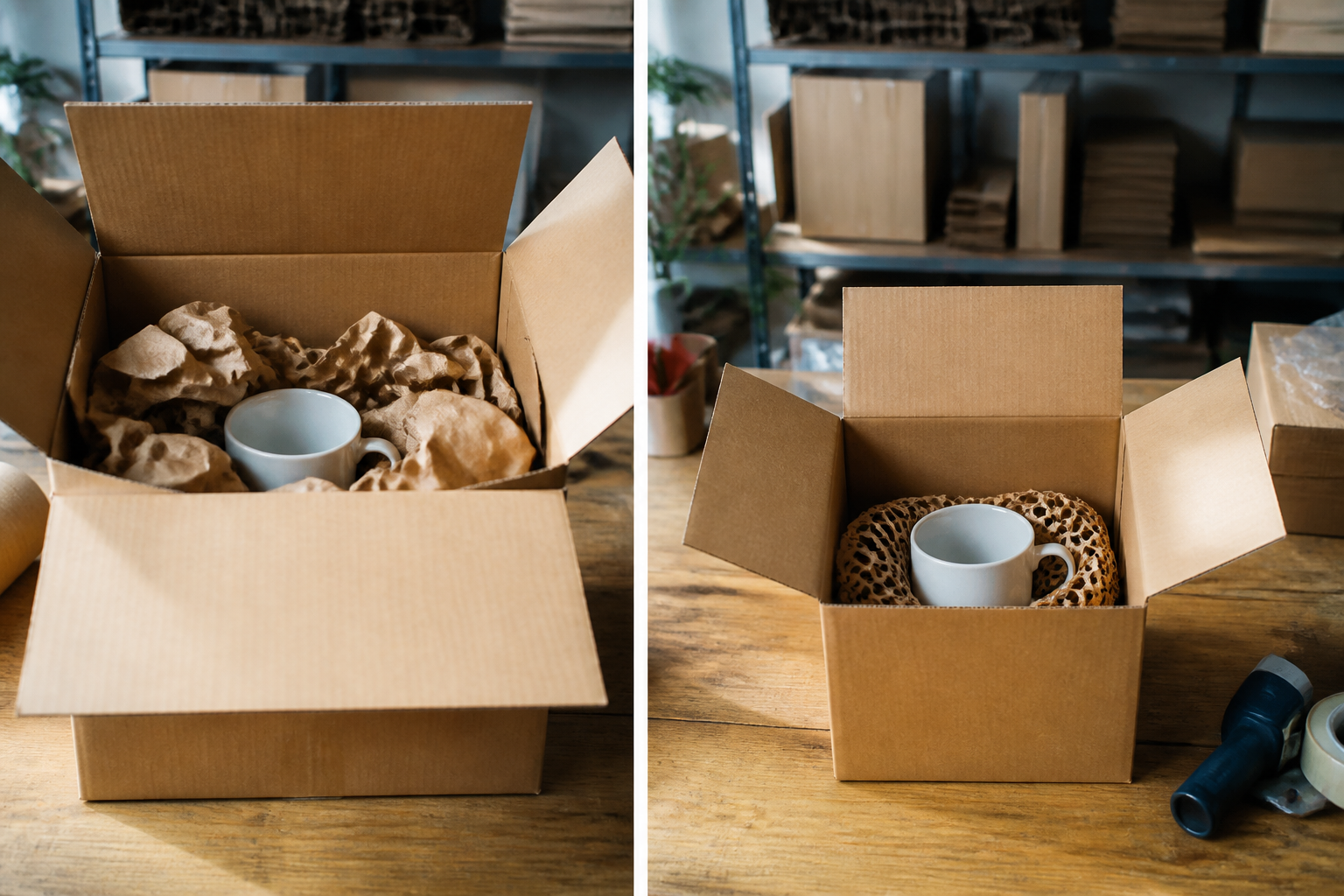
Safe fits include tees, leggings, linens, and other foldable goods. Bad fits: mugs, framed goods, jars, and brittle packs—even if the post office accepts the mailer, damage claims erase the savings.
How bubble mailers, kraft-lined options, and standard poly mailers fit different SKU types
Standard mailers work for soft SKUs; large poly mailers suit bundled apparel orders. For printed matter or flat units, teams may pair inserts with butcher paper to stop scuffing. If a brand wants a paper look, kraft paper bags can suit lighter goods; they still need product-by-product testing.
USPS rules, postal handling, and address-readiness: what brands need to know before using poly mailers
Does USPS allow poly mailers? Yes—it accepts poly mailers for mail and shipping if the pack is sealed well, the address scans cleanly, and the contents can handle postal handling. In practice, soft packs get sorted on belts, dropped into bins, stacked under other posts, and pushed through barcode equipment, so product fit matters fast.
Does USPS allow poly mailers, and what does postal service handling actually look like
Soft goods usually travel well in poly mailer bags and other poly bags for shipping, but breakable items don’t. Apparel, refill pouches, and folded textiles are usually fine. Books with sharp corners, boxed cosmetics, and anything crush-sensitive need more structure.
For brands comparing format options, poly bubble mailers can protect small accessories better than flat film mailers (but they still aren’t a substitute for corrugated protection).
Label placement, address quality, barcode scan rates, and mailing record issues that cause delays
Bad labels cause slowdowns.
A wrinkled surface, low-contrast printing, or a taped-over barcode can hurt scan rates and delay service.
Experience makes this obvious. Theory doesn’t.
- Place the shipping label on the flattest face
- Keep the address away from seams and the opening flap
- Don’t overstuff large poly mailers
- Keep a mailing record tied to the order ID and prepaid label
Certified mail, prepaid labels, returns, and redirect requests: where soft-pack shipments can get messy
Here’s what most people miss: returns and redirect requests fail more often when the pack has no spare panel for a new postal label. Brands using lightweight shipping mailers instead of boxes should leave room for a second label, a return address, and any certified or barcode stickers.
Inside the pack, a single wrap of butcher paper can stop show-through, while kraft paper bags work better as inner retail wrap than outer mailers.
How to choose poly mailers by size, mil thickness, seal strength, and print use
Roughly 1 inch of extra air in a mailer can push damage claims and postage waste higher than most teams expect. In practice, the best poly mailers are sized close to the folded product, not the wishful product, and that one choice shapes shipping cost, postal scans, and customer service.
Size selection for apparel, refill packs, documents, and flat goods without overpacking
Apparel, refill packs, and flat goods fit best in poly mailer bags sized to the final fold, while documents usually need cleaner edges than loose kraft paper bags or a wrap of butcher paper.
For bulk apparel orders or oversized bundles, large poly mailers help, but dead space should stay low.
When 2.5 mil works, when 3.0 to 3.5 mil is the safer choice, and when to move to a box
Plain truth. 2.5 mil works for T-shirts, soft accessories, and other non-fragile poly bags for shipping. Move to 3.0 to 3.5 mil for sharper corners, higher return rates, or long mail routes. If the item can crack, dent, or bend, skip mailers and use a box.
- 2.5 mil: soft goods under 2 lb
- 3.0-3.5 mil: denser packs, rougher handling
- Box: breakable or rigid items
Printed poly mailers, plain white bags, and branded mailer options for direct-to-customer presentation
Branding matters — but only after fit and seal. Plain white bags look clean, printed mailers sharpen direct mail presentation, and lightweight shipping mailers instead of boxes can trim spending fast for repeat-post orders.
Weather resistance, tear strength, and tamper signs that affect customer service outcomes
Look for strong side welds, a clean self-seal strip, and visible tamper signs after opening (that cuts “empty bag” disputes). For small items that need cushioning, poly bubble mailers beat loose fill in a soft mailer, especially in rain, sorting belts, and last-mile handling.
Real results depend on getting this right.
Where poly mailers save money fast and where they quietly create cost
Think of this the way an ops lead would explain it over coffee: poly mailers can cut postage fast, but the real win shows up only when a brand tracks total landed cost, not just the unit price on a post or office supply invoice. For apparel, soft accessories, and refill packs, poly mailer bags and other poly bags for shipping often beat cartons by $0.20 to $0.90 per order once dim weight and filler are counted. Bad fit flips that math in a hurry.
Unit price versus total shipping cost: the numbers brands should record every month
- Package cost: mailer, label, tape, inserts
- Postal cost: actual mail or USPS charge by zone and weight
- Labor time: pack time in seconds
One common example: a tee in lightweight shipping mailers instead of boxes may cost 6 ounces to ship; the same order boxed with butcher paper can jump past 10 ounces. That changes the mailing rate.
Damage claims, remake rates, and return handling for mailers used the wrong way
Here’s what most people miss—damage cost hides in remake labor, customer service email volume, and return handling. Poly bubble mailers work for flat goods with light edge risk. They don’t fix the crush risk. Cosmetics with pumps, candles, and rigid sets sent in large poly mailers tend to fail in sorting.
A practical test plan for online brands: split shipments, track results, and set a target mix by SKU
Run a 30-day split test: 50 orders in boxes, 50 in mailers. Track damage rate, return rate, and cost per shipped order. Add notes on printing quality, address scan issues, and whether kraft paper bags or inserts changed presentation enough to matter. [redacted] set a target mix by SKU—not by habit.
Frequently Asked Questions
Does USPS give you free poly mailers?
No—standard poly mailers usually aren’t handed out for free by USPS. Postal service locations may offer certain Priority Mail mailing supplies at no charge for that service tier, — plain poly mailers for general shipping are usually purchased by the seller.
Does the USPS allow poly mailers?
Yes. USPS accepts poly mailers as long as the package is sealed well, the delivery address is clear, and the contents are packed safely for the mail stream. If the item is fragile, sharp, or crush-prone, a corrugated box works better.
Where can I get free poly mailers?
For regular e-commerce use, free poly mailers are rare. A business may get no-cost mailing supplies tied to a specific prepaid postal service, but those aren’t a blank check for any post or carrier use—read the service rules before ordering.
Where can I get cheap poly mailers?
Online packaging sellers, shipping supply sites, and bulk distributors usually have the best pricing on poly mailers.
What size poly mailer should be used for clothing orders?
Pick a mailer that fits the folded item with a little room for the adhesive flap, not a lot of empty space. For one T-shirt, brands often use 10×13 or 12×15.5 bags; bulkier items like hoodies or multi-piece subscription orders may need 14.5×19 or a box instead.
And that’s where most mistakes happen.
Are bubble mailers better than poly mailers?
Not always. Bubble mailers add a built-in cushion, which helps for small accessories, media items, and products that can handle light pressure but still need some surface protection. Plain poly mailers are a better choice for soft goods like apparel, where extra bulk just raises shipping costs.
Can poly mailers be used for subscription boxes or branded mailing?
Yes, if the product mix is right. For soft, flat, and low-breakage shipments, branded poly mailers can improve presentation without paying for a custom box—especially for direct-to-consumer apparel, refill packs, and light accessories. If the unboxing moment matters more than postage savings, a mailer box still wins.
Are poly mailers waterproof?
Mostly, yes. Poly mailers resist rain, splashes, and normal transit moisture, which is one reason they’re common for shipping clothing and fabric goods. They aren’t a license to skip inner protection for items damaged by condensation, ink transfer, or pressure.
Can poly mailers be recycled?
Some poly mailers can be recycled through store drop-off programs that accept plastic bags — film, but curbside recycling usually won’t take them. If a mailer has mixed materials—like bubble lining, paper layers, labels, or extra printing—the record gets messier fast, so brands should check the local rules before making claims on-pack.
When should a brand avoid poly mailers altogether?
Simple answer: don’t use poly mailers for anything fragile, heavy, rigid-cornered, or premium enough that dents ruin the customer experience. In practice, if the item can’t survive a conveyor drop, a stacked parcel, and a wet porch in just a flexible bag, it doesn’t belong in one.
Most people skip this part. They shouldn’t.
For brands shipping 25 to 500 orders a month, packaging choice isn’t just a fulfillment detail. It’s a marginal decision that shows up in postage, storage, labor, and damage rates week after week. Poly mailers make sense when the product can handle compression, the bag is sized correctly, and the film strength matches the item inside. Get those three things right, and the savings are real. Get them wrong, and the supposed savings vanish in remakes, returns, and support tickets.
That’s the shift smart operators are making. They’re not replacing every box. They’re sorting SKUs by risk, testing soft-pack shipments where protection needs are low, and watching the numbers closely—postage per order, claim rate, return condition, and pick-pack speed. That’s where the cash-flow gain shows up.
The next move should be practical: pull the last 30 days of shipments, flag every order that could have shipped in a mailer, and run a 50-order test by SKU type with two approved mailer specs.
UCANPACK
753A Tucker Rd
Winder, GA 30680
1 201-975-6272